
Healthcare cost containment means using plan design, funding structure, and decision support to reduce total spend without cutting benefits. The most effective levers are self-funding, reference-based pricing, HDHPs paired with HSAs, and steering employees toward better decisions at the point of choice.
If you’re like many HR pros, containing healthcare costs has become a top priority in the last several years. But that goal is becoming more and more elusive each year.
Between rising medical expenses, tighter budgets, and employees who still expect affordable, high-quality coverage, you’re faced with a pretty tall order: controlling healthcare costs without making employees feel like they’re getting less.
Cost containment in healthcare isn’t as simple as picking the cheapest plan and hoping employees enroll in it. Every decision, from how you fund your plan to how employees choose their coverage, can affect both your organization’s bottom line and your people’s experience.
But containing healthcare costs doesn’t have to mean cutting benefits or shifting more of the burden to employees. Strategies like self-funding, reference-based pricing, HDHPs paired with HSAs, and benefits decision support offer employers other ways to manage rising costs.
What is healthcare cost containment?
Healthcare cost containment is a strategy employers use to control healthcare spending while maintaining valuable employee benefits. Leading organizations take a multi-pronged approach, bringing down costs through a combination of creative plan design, funding strategies, unique pricing models, and employee decision support tools.
Before we get too deep into those strategies, let’s pause for an important note: cost containment isn’t the same as cost cutting.
Cost cutting might include eliminating benefits across the board, increasing employee contributions, or raising deductibles. And we’re certainly not suggesting that you start indiscriminately slashing resources.
Cost containment, on the other hand, takes a broader view. The goal is to identify unnecessary spending and find ways to reduce it, without compromising the coverage employees actually need. That can mean taking a closer look at:
- How health plans are funded
- How much you pay vs. how much your employees contribute
- How providers are reimbursed
- Which plans employees enroll in
- Whether employees understand their benefits options throughout the year
In other words, the most effective healthcare cost containment strategies don’t necessarily ask employees to use their benefits less. They simply help you and your workforce spend your dollars more intentionally.
That goal is becoming increasingly important for C-suite leaders as they plan for the year ahead. With limited budgets and record-high healthcare costs, executives are putting more pressure than ever on their HR teams to find cost-saving measures.
For many organizations, the answer isn’t one magic cost-saving tactic. It’s a combination of strategies that work together. In the next few sections, we’ll dive into the most common (and effective) ways to make it happen.
How do self-funded plans reduce costs?
A self-funded health plan is one in which the employer pays for employees’ healthcare claims instead of paying a fixed premium to an insurance carrier.
A fully insured plan is what most folks think of as traditional employer-sponsored healthcare. With these plans, you, as the employer, pay your insurance company a predetermined premium, while a carrier assumes responsibility for any claims your employees file.
With a self-funded plan, you, as the employer, pay employees’ claims as they occur, often using a third-party administrator (TPA) to handle plan administration and claims processing.
That difference can create opportunities for cost containment, like:
Greater visibility into healthcare spending
When you pay a fixed premium every month, it can offer a false sense of security. Of course, it’s comforting to know that you’ll have steady, predictable costs throughout the year! But fixed-premium plans don’t always give you insight into every dollar of your employees’ healthcare spending.
When you’re covering claims costs yourself, there are multiple opportunities for savings. If your employees are healthy and don’t use their benefits often, that means lower costs and less unnecessary spending for you!
And if they’re not healthy, your claims data will offer a deeper dive into what’s happening so that you can save more down the road—by identifying your employees’ highest-cost conditions, healthcare utilization trends, or other areas where your plan design could be improved.
More flexibility in plan design
Self-funded plans also give you more wiggle room to design a plan that fits your particular employees’ needs.
That could include creative approaches to networks, pharmacy benefits, care management, or employee cost sharing. If your workforce is mostly young and healthy, you might opt for lighter coverage at a lower cost to you. Or if your employees skew older, you might offer a more robust plan.
Personalizing your plan design to fit your organization’s unique demographics can help ensure employees get the right coverage without overspending.
The tradeoff: more financial risk
Self-funding isn’t automatically cheaper, and it isn’t the right fit for every employer. The biggest consideration is financial risk.
With a self-funded plan, you’re on the hook for all claims costs—no matter how much your employees use their health plan. A year with unexpectedly high claims can create significant financial stress if your company is unprepared.
That’s where stop-loss insurance comes in. Stop-loss coverage protects employers from catastrophic claims above a certain threshold, helping make the financial risk of self-funding more manageable.
Ultimately, if you’re considering self-funding, your organization should weigh the potential savings opportunities against your financial capacity, workforce makeup, and general tolerance for risk.
What is reference-based pricing?
Reference-based pricing (RBP) is a model where an employer sets their own maximum reimbursement limits for specific medical services, rather than negotiating prices through a provider network.
One limitation of traditional health plans is that you and your employees are beholden to the rates a healthcare provider sets, no matter how high they get. Reference-based pricing flips that script, letting employers ask, “What are we reasonably willing to pay for this service?”
For example, let’s say you’re setting a reference price for knee replacements. You might look at publicly available data (like Medicare rates) to determine the procedure’s base cost, padding it by 20-30% to account for profit margins and regional pricing.
Setting a reference price for knee replacements
- Medicare reimbursement cap: $1,736
- Your reference price (130% of Medicare reimbursement): $2,257
Your employees can then choose any provider that accepts the reference price you’ve set.
How is reference-based pricing different from network-based pricing?
Instead of relying on your carrier to build a provider network and negotiate rates with each provider, reference-based pricing gives you power as an employer by establishing payment benchmarks employees can use virtually anywhere.
That means your workforce can say goodbye to the old “in-network vs. out-of-network” headache. A reference-based model lets them visit any provider that offers care at or near the rates you set—meaning more choice and less red tape when finding the right fit.
The biggest benefit: controlling provider costs
One of the biggest advantages of RBP is that it gives you more control over your financial responsibility for the healthcare services your employees use.
Costs can vary dramatically from one provider to another, even for the same service. Reference-based pricing lets you establish a reasonable payment amount rather than automatically accepting whatever price a provider or network has negotiated.
RBP can also be particularly powerful when combined with a self-funded plan. You’re already assuming responsibility for all of your employees’ claims costs, so the ability to set maximum reimbursement rates offers a bit more predictability and gives you greater financial security.
The potential drawback: balance billing
There’s an important caveat, though.
If a provider doesn’t accept your reference price, your employees may face a balance bill for the difference between the provider’s charge and what your organization’s health plan pays.
That can create confusion and frustration for employees—and potentially unexpected costs.
So if your organization is considering RBP, spend extra time on your benefits communication plans. Remember: most employees don’t have experience with reference-based pricing, so they might need a little extra hand-holding.
That means deeper explanations about what RBP is, how it works, how to find providers who accept your reference prices, and what steps to take before receiving care.
How do HDHPs paired with HSAs contain costs?
A high-deductible health plan (HDHP) paired with a health savings account (HSA) combines a low-premium, high-deductible health plan with a tax-advantaged account that employees can use for eligible healthcare expenses.
With an HDHP, employees generally pay more out of pocket before the plan begins paying for covered services. An HSA can offset those upfront costs by giving them a tax-free savings fund to cover qualified healthcare expenses.
When used effectively, an HDHP + HSA combo can significantly improve your cost containment strategy by changing how employees think about and pay for care.
How does an HDHP change healthcare decisions?
Because an HDHP puts more responsibility on your employees to cover their own healthcare bills, they’re likely paying closer attention to how much each service costs. That means they’re more motivated to compare prices, consider lower-cost options, and think carefully about whether a particular service is necessary.
That doesn’t mean employees should avoid the care they need. Instead, the goal is to encourage more informed decisions about where, when, and how they receive care. For example, employees who opt for an HDHP might be more likely to:
- compare the cost of receiving a service at the ER versus urgent care
- use telehealth for a minor concern
- choose a lower-cost generic prescription
Where does an HDHP + HSA work best?
This strategy tends to be easier to implement when employees are young, healthy, and have enough financial flexibility to manage a higher deductible, and when you (the employer) offer meaningful education and support.
Read that last part again.
A strong communication strategy is key to success with HDHP + HSA plans. Simply offering an HDHP doesn’t automatically make employees better healthcare consumers. If they don’t understand deductibles, coinsurance, out-of-pocket maximums, or how their HSA works, a plan that’s designed to encourage cost-conscious decisions can instead feel confusing or risky.
That’s why HDHPs and HSAs work best as part of a broader cost-containment strategy, not as a standalone solution.
How does benefits decision support lower plan costs?
A strong benefits decision support strategy guides employees during open enrollment and beyond, helping them choose the best plans and make smarter decisions year-round. It offers personalized, trusted advice based on their individual needs, preferences, and expected healthcare use.
It’s also one of the most direct ways you can contain healthcare costs as an employer—by meeting your workforce in the moment, when they’re actually using their benefits. And unlike some cost-containment strategies, decision support doesn’t require you to change your plan designs, or ask employees to take on more financial risk.
Instead, it focuses on a singular question: “Where are employees lost, confused, or overspending—and how can we steer them towards more cost-effective solutions?”
The cost of choosing the wrong plan
Unfortunately, your workforce is making a lot of incorrect assumptions about their benefits.
Well-intentioned as they may be, 1 in 4 employees choose a health plan that isn’t the most financially advantageous for them. Maybe they opt for a steep premium because they assume it’s the “higher-value” option. Or they may choose a low-premium plan without fully considering how a higher deductible could affect them if they have a surprise medical need.
Those decisions affect both employees and employers. Recent data shows that almost 25% of healthcare spending in the US is considered wasteful, largely due to employee confusion, unnecessary medical processes and procedures, and lack of knowledge about lower-cost alternatives.
That comes at a huge cost to your organization: each healthcare misstep wastes an average of $2,173 per employee. At a 1,000-person company? You could be throwing away $2.1 million per year.
How does decision support affect employer healthcare costs?
This is where personalized benefits decision support can become a powerful tool for cost containment.
For years, benefits decisions were often treated as an HR problem: How do we get employees enrolled? How do we answer their questions? How do we make open enrollment a little less painful?
But healthcare costs aren’t just an HR line item anymore; they’re a C-suite concern. Mercer found that a third of CFOs now rank benefits spending among their organization’s top three operating expense concerns, up from just 19% in 2024. CFOs also reported that rising healthcare costs are affecting other areas of the business, including other benefits, wage growth, and product and service prices.
And the pressure isn’t easing. Employer health benefit costs are projected to increase by 8.2% in 2027—the highest increase since 2003.
So in today’s world, employee benefits confusion isn’t a small problem. It’s an organization-wide alarm bell. 🚨
That’s where a decision support tool like ALEX comes in. From helping employees choose the best plan at enrollment to supporting in-the-moment benefits decisions throughout the year, ALEX provides conversational guidance that feels like talking to a trusted HR rep.
The best part? ALEX nudges your workforce towards more financially savvy choices that are good for them and you. From preparing for a surprise medical bill to searching for lower-cost options, ALEX drives benefits decisions that contain healthcare costs for your employees and your organization.
Decision support can also reinforce other cost-containment strategies
Want to compound the effects of your healthcare cost containment strategy? Layer in a benefits decision support plan.
Why? Well, let’s think about the other topics we’ve covered:
- Self-funding can give employers more control and visibility into healthcare spending.
- Reference-based pricing can establish clearer benchmarks for what the plan will pay.
- HDHPs and HSAs can create stronger incentives for cost-conscious healthcare decisions.
Sounds great! But at the end of the day, employees still need to understand what all of those concepts mean. And that’s where decision support can connect the dots.
ALEX supports your cost containment strategies
Benefits decision support isn’t just about making open enrollment easier. It’s a way to make your organization’s benefits investment work harder every day and maximize the impact of your other cost-containment efforts.
And when healthcare budgets are under increasing scrutiny, that’s a message your C-suite will want to hear.
Putting it together: A cost containment framework for HR teams
No single healthcare cost containment strategy will work for every employer. The strongest approach is usually a combination of levers that address different parts of the healthcare spending equation.
Healthcare cost containment strategies: weighing the pros and cons
Cost containment strategy
Potential benefits
Potential tradeoffs
Self-funded plans
- Greater control and visibility into healthcare spending
- More flexibility in plan design
- Potential for savings when claims perform well
- Your organization takes on more claims risk
- Requires careful financial planning and stop-loss coverage
Reference-based pricing
- Can help your organization establish more predictable healthcare payment benchmarks and reduce excessive provider costs
- Providers may not accept the reference price, creating potential for balance billing
- Requires strong employee education and support
HDHPs + HSAs
- Can encourage more cost-conscious healthcare decisions
- HSAs give employees a tax-advantaged way to save for eligible expenses
- Higher deductibles can create financial strain or confusion for employees
- Works best with clear education and guidance
Benefits decision support
- Helps employees understand their options and choose coverage that fits their needs
- Can reduce unnecessary spending from poor plan choices
- Supports the overall employee experience
- Effectiveness depends on personalization, employee engagement, and the quality of the guidance
If you’re wondering which cost containment strategies your organization should implement, here’s a simple framework that your HR team can use:
1. Evaluate your funding structure
Ask whether self-funding could give your organization greater control, flexibility, and visibility into healthcare spending.
Things to consider: workforce size, claims volatility, financial risk tolerance, and stop-loss coverage.
2. Look for opportunities to control provider costs
Evaluate strategies such as reference-based pricing that can establish clearer benchmarks for healthcare payments.
Things to consider: potential savings, provider acceptance, balance-billing risk, and employee communication.
3. Give employees a reason—and a way—to make cost-conscious choices
Consider HDHPs paired with HSAs when they’re appropriate for your workforce and supported by strong education.
Things to consider: employee financial readiness, workforce demographics, plan affordability, and how well employees understand the plan.
4. Help employees choose the right benefits
Use a personalized benefits decision support tool like ALEX to help employees understand their options and select coverage based on their individual circumstances.
Things to consider: personalization, ease of use, and measurable outcomes.
5. Measure what happens next
Cost containment shouldn’t end when employees enroll.
Throughout the year, look at enrollment patterns, plan utilization, employee costs, employer costs, and other relevant outcomes to understand what’s working—and where there’s room to improve.
Things to consider: automated reporting, claims spending summaries, access to historical data
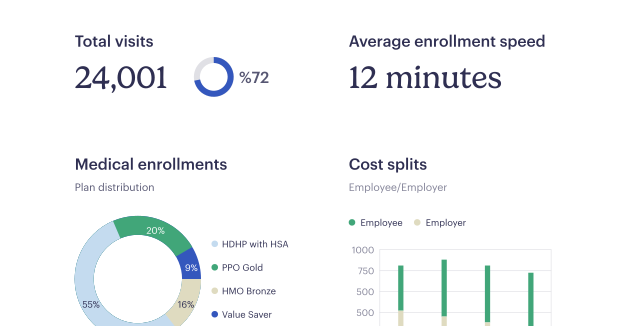
ALEX Home offers analytics that show the value of your benefits
Real-time dashboards track engagement, enrollments, and plan selection trends for HR and brokers alike.
The bottom line
Healthcare cost containment isn’t about asking your workforce to settle for less. It’s about finding smarter ways to spend the healthcare dollars that you and your employees are already investing.
Self-funded plans, reference-based pricing, and HDHPs + HSAs are all creative ways to address this current moment.
And benefits decision support can tie all of those strategies together, by helping employees choose (and use) the coverage that’s actually right for them, ensuring your benefits investment doesn’t go to waste.
That’s the big win here! 🎉 When employees understand their options and make better-informed decisions, cost containment doesn’t have to come at the expense of the employee experience. It can actually improve it.

